

One of the largest private research centres in Italy, CETMA brings its extensive experience in innovative materials and processes to the REFRESH project. CETMA is leading Work Package 6, which encompasses the REFRESH design for circularity strategy and the project’s life cycle assessment activities.
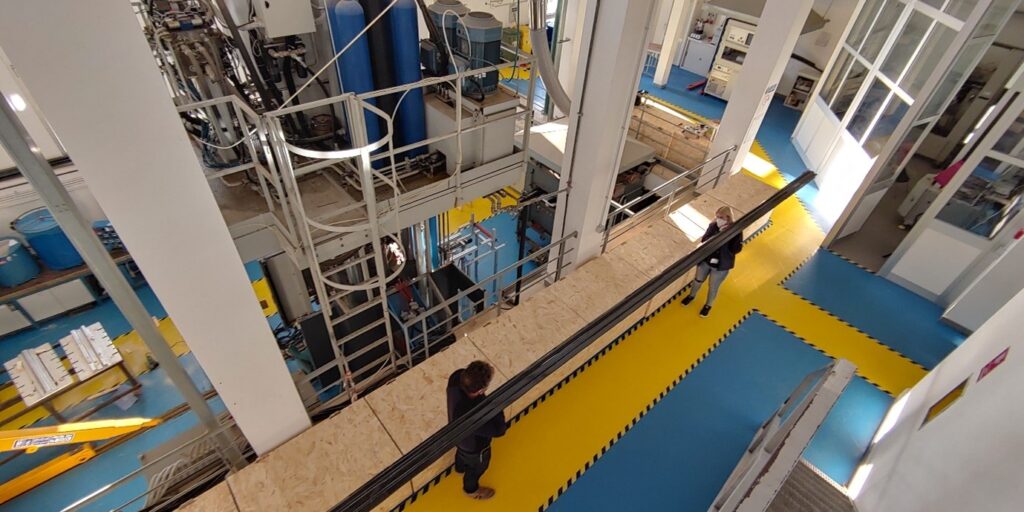
The CETMA team showing a full-scale carbon fibre composite stringer component developed for aeronautics, manufactured by continuous compression moulding. (Picture © CETMA.)
CETMA (Centro di Ricerche Europeo di Tecnologie Design e Materiali) is a not-for-profit Italian research and technology organisation (RTO). Its mission is to support companies in their growth process by the exploitation of research results. CETMA possesses more than 25 years of experience in applied research, experimental development and technology transfer in the field of advanced materials, ICT, and product development. Its 65 staff include researchers, engineers, designers and project managers.
CETMA is located in Brindisi and organised into two departments: AMP (Advanced Materials and Processes Department) and NED (New Technologies and Design Department). Since it was founded in 1994, CETMA has managed 127 independent research projects, 20 higher education projects, 1354 commercial projects, and 38 European projects.
CETMA has invested significantly in the composite materials field in terms of both facilities and competencies. It is becoming more and more a point of reference at European level for companies that aim to penetrate the growing composites market. CETMA’s activities in the REFRESH project will be carried out by the Advanced Materials and Processes Department, which is organised into four groups: Material and Characterisation, Technologies and Processes, Modelling and Simulation, Diagnostic and Structural Health Monitoring. These groups are specialised in polymeric and composite materials, with a specific focus on composites recycling.
CETMA’s role in REFRESH
CETMA is leader of Work Package 6: Circular by design, collaborating with RINA, Gees Recycling, CIRCE, Gjenkraft, Tecnalia and Acciona. This work package’s main objectives are to develop new products using the secondary raw materials from the REFRESH processes, and conduct sustainability analyses of the REFRESH recycling processes and different end products.
CETMA is responsible for the REFRESH eco-design strategy. This task aims to formulate eco-design guidelines for the manufacturing of new products with secondary raw materials. These focus on three areas: concept design, design for recycling, and design for disassembly. This work will be completed in June 2024.
CETMA will then lead the task to manufacture end-products using high amounts (up to 95 wt%) of secondary raw materials. This will take into consideration end-user requirements, the technical performance of the products and of the secondary raw materials, as well as environmental and economic parameters. This task starts in July 2024 and runs until the end of the project.
We asked Andrea Tinti, Senior Researcher and Project Manager, about CETMA’s involvement in the REFRESH project.
What is CETMA’s experience in the wind energy sector?
CETMA has been working on composite materials since the beginning of its history, with a strong focus on aeronautic, transportation and marine applications. More recently we also took to the field in the wind energy sector, a very interesting and challenging industry covering a significant slice of the whole composites market.
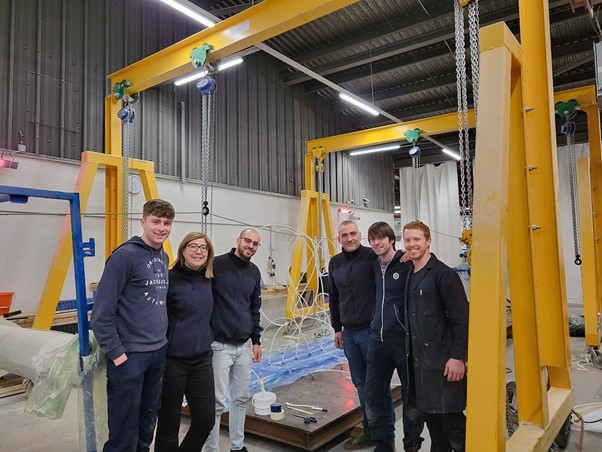
CETMA and ÉireComposites manufactured a thermoplastic wind blade as part of the Marewind project. (Picture © CETMA.)
As well as REFRESH, CETMA is working in the Marewind project (2020-2024), a large-scale European initiative aiming at improving the offshore wind energy sector by providing advanced durable materials and recyclable solutions, and by extending the service life of the wind facilities.
Marewind follows the so-called design approach, dealing with the development of new materials for future blades with improved performance in circularity. New materials with higher recyclable potential in respect to traditional thermosetting resins have been studied, e.g. reactive thermoplastics and cleavable epoxies, along with the related recycling procedures. Then, CETMA, together with partner ÉireComposites (Ireland), developed and manufactured a thermoplastic wind blade to validate the new materials and processes.
What attracted CETMA to the REFRESH project?
REFRESH is strongly focused on marketable solutions, involving the entire reverse circular value chain of wind energy sector: from end-of-life rotor blades to a wide range of recycled (and repurposed) products. Participation in this initiative is a remarkable opportunity to contribute to the European Union’s circularity goals. Moreover, REFRESH will act on both end-of-life and eco-design approaches, resulting in a very transversal project.
The end-of-life approach aims to manage the waste arising from existing blades reaching the end of their service life today. These were designed and manufactured 20-25 years ago with no circular criteria, but only for performance. On the other hand, the most preferred option would be the prevention of waste. That can be obtained by means of a proactive approach known as eco-design. The REFRESH project also offers the opportunity of working on eco-design by applying this approach to a wide range of new products developed from end-of-life wind blades.
“The REFRESH project is strongly focused on marketable solutions, involving the entire reverse circular value chain of wind energy sector: from end-of-life rotor blades to a wide range of recycled (and repurposed) products.”
What are the main challenges in developing a circular economy strategy for wind turbine blades and how is the project aiming to solve these?
Wind turbine blades represent a challenge at the end of life due to the materials used, especially thermoset resins, and their complex composition. In this framework, the main challenges to face are:
- Deployment of recycling technologies and repurposing strategies, which can significantly vary by technological readiness level (TRL), cost, value of the recovered material, but also potential environmental impact (CO2 emission and energy demand);
- Development of recycled/repurposed products and related markets that should be able to receive the increasing large quantities of composite waste from the wind sector.
Engagement with other sectors using composites will also be important because related technologies could be shared to some extent, improving both efficacy and efficiency.
With regards to the future, design for X strategies is the key factor, such as design for long life, design for life extension, design for disassembly, design for recycling etc. We will explore some of these in relation to new products from end-of-life wind blades.
What types of products could be developed from the recycled materials from the REFRESH processes?

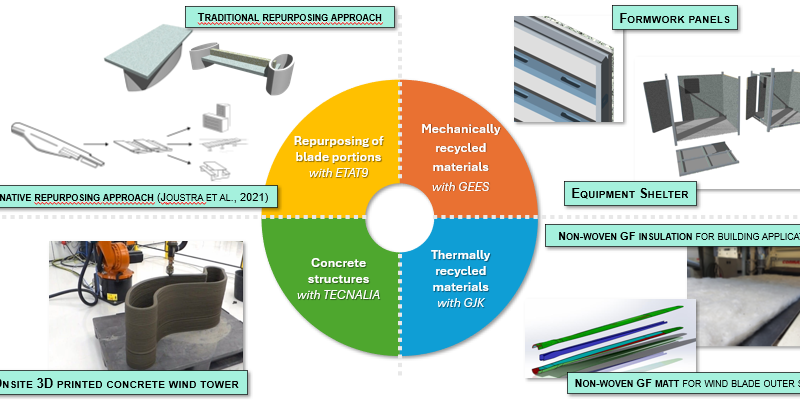
The approach of REFRESH Work Package 6: Circular by design.
We are exploring, together with the partners, several opportunities based on market request (and confidence).
Secondary raw materials from the mechanical recycling process will be used to produce recycled panels. These could substitute traditional materials in framed formwork (e.g. to pour new wind blade concrete foundations) or prefab shelters for telecoms or worksites.
But a number of further applications is under evaluation. The whole Phase 2 of the project will be focused on these studies. Reclaimed glass fibres from the thermal recycling process (pyrolysis) could be reprocessed into recycled nonwoven matt/slab. This could be used for several applications e.g. thermal insulation for buildings with inherent flame-retardant properties, but also non-structural parts for new wind blades. Also, 3D printing of a scaled wind tower will be developed, made of cement-based materials reinforced with recycled fibres.
Finally, repurposing solutions will be studied, both traditional and novel approaches. Typically, repurposing consists of reusing the full blade or a cut section for a different application. To extend the range of potential usage, segmentation of the blade into standardised construction elements will also be explored.
What do you hope to have achieved by the end of the project?
The goal is to develop a wide portfolio of applications exploiting all the REFRESH processes, and having an optimal balance in technical, economic and environmental performance. We have to avoid any gap due to the use of recycled material, be aware of costs needed for implementation and also of the potential market demand, and carefully evaluate the overall environmental benefits by means of quantitative life cycle assessment methodologies.
It is a long road to a fully circular wind energy supply chain. With REFRESH we aim to bring the sector a few steps closer.
Read about our other partners:
- ACCIONA
- CIRCE
- Enecolab
- ETAT9
- EuCIA
- Gees Recycling
- Gjenkraft
- MTB Manufacturing
- RINA Consulting
- TECNALIA
The REFRESH eco-design strategy